









































By Tamara L. Young, PhD, PID for the World’s Luckiest Fishing Village
This month Mayor Wagner and I sat down to discuss why beachfront lighting is one of the most important choices we can make for Destin’s sea turtles.

TY: People hear “sea turtles” and “lighting”, and they reach for flashlights that emit red light. That’s a big step, but there’s an even bigger story of lighting, and it is the buildings themselves. How beachfront houses and condos can support nesting sea turtles is the narrative we need to push in 2026.
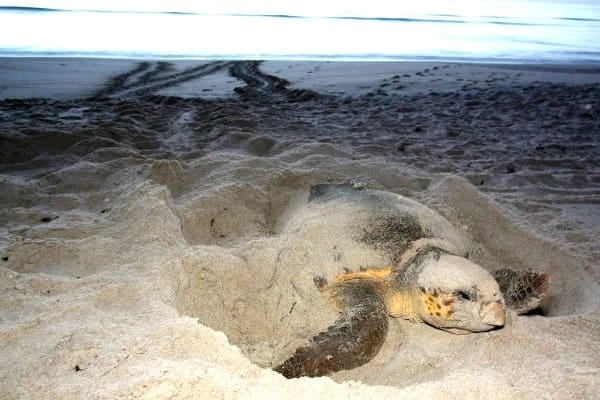
BW: A flashlight matters, but it is one beam for one person on one walk. The lighting on a beachfront condo runs every night for months, and it points at the same stretch of sand whether anyone is home or not. When the Florida Fish and Wildlife Conservation Commission talks about protecting nesting beaches, the thing they keep coming back to is artificial light from structures. A nesting female will avoid a brightly lit beach altogether, and the hatchlings that do emerge crawl toward the brightest horizon they can see. On a natural beach, the open Gulf glows. On a developed one, too often, it is somebody’s back porch.
TY: We had a season not long ago in a neighboring city where nearly every hatchling from the early nests was disoriented by beachfront lighting — turned the wrong way, away from the Gulf. That is the saddest! These are animals that have been finding the water by instinct for tens of millions of years, and a porch light overrides that in a single night. Every condo really does matter.
BW: It does, and here’s the encouraging part: because lighting is the problem, lighting is also the fix, and it’s a fix that’s almost entirely in the property owner’s hands. FWC boils it down to three things they call the golden rules of beachfront lighting: Keep it low, keep it long, and keep it shielded. Low means mount the fixture as low to the ground as it can be while still doing its job. You want light on the steps, not broadcast over the dune line. You also want to use the lowest wattage possible. Nobody needs a floodlight to find a door handle. Dial it down and you’ve helped the turtles and your power bill in the same move.
TY: Win-win! And then there is “long”, which is a bit counterintuitive. It’s about wavelength. Sea turtles are far less sensitive to long-wavelength light, like amber, orange and red, at 560 nanometers or greater. Short-wavelength white and blue light is what disorients them. It’s the same reason our giveaway flashlights at City Hall are red rather than white. The good thing is the turtle-safe amber and red LEDs you’d put in an outdoor fixture are widely available now, and
BW: Which brings us to the last rule, shielded. The fixture has to be fully cutoff, meaning no light escapes above a 90-degree plane, and you should not be able to see the lamp or the glowing lens at all when you are standing on the sand. Globe lights and old carriage lamps that throw light in every direction are the classic offenders, and they are usually an easy swap.
TY: So, that covers the exterior. But it’s also important to realize that the interior lights of a condo can actually be the worst culprit. These are often brighter than anything outside, and they can shine straight through a big glass slider toward the water.
BW: For our taller condos, it may be the single biggest issue. A wall of glass facing the Gulf is essentially a lighthouse if the lights are on and the blinds are open. The good news is the fixes are about as easy as it gets, and most of them are free. Close the curtains or blinds after dark. Move lamps back away from the windows. Small habits, big difference for a nest just past the dune.
TY: And for the units that want a permanent solution, window tint is the gold standard. FWC points to tint that allows 45 percent or less of the interior light through to the outside, and darker is better on those big glass-front units. Pool lights are a bit trickier because the water reflects and spreads the glow, so the recommendation there is to lock the pool light on an amber or red setting through at least May-October, which is sea turtle nesting season.
BW: Almost everything we have talked about, closing a blind, swapping a bulb to amber, aiming a fixture down, flipping off the decorative lights, costs little or nothing and works the very night you do it. If every owner on the beach made one change before next season, we would see it in the survey numbers.
TY: Sea turtles are one of our favorite visiting groups each year that we all agree we want coming back!
BW: They have found their way to this coast for tens of millions of years, long before any of us got here. The least we can do is leave the horizon dark enough for them to find it again. Lights out for loggerheads. It is that simple, and it is that important.